
Large Core Fiber Patch Cord Guide: General-Purpose, Infrared, and UV Specialty Fiber Cables
Updated at Nov 02nd 2026 Views 15
A large core fiber patch cord is designed for a different job than standard telecom fiber. Instead of carrying high-speed modulated data over a 9 µm single-mode core or a 50/62.5 µm multimode core, a large core fiber patch cord uses a much larger core—typically from 105 µm up to 400 µm, 600 µm, or 1000 µm—to deliver optical power safely. The larger core area reduces power density at the fiber end face and along the fiber, making these cables ideal for laser delivery, spectroscopy, sensing, medical systems, and industrial optical equipment.
However, “large core” is only one part of the selection. The fiber material determines the usable wavelength range and the dominant failure mode. In practice, buyers usually compare three categories: general-purpose large core fiber patch cords, infrared specialty fiber patch cords, and UV specialty fiber patch cords. Each has distinct features, application ranges, and engineering trade-offs.
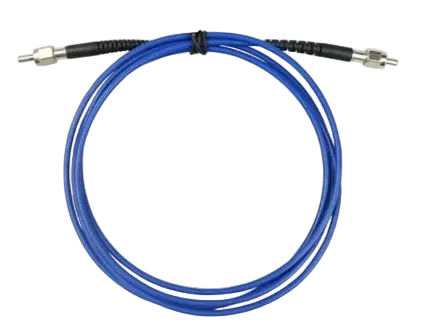 HC Large Core Fiber Patch Cord
What Is a Large Core Fiber Patch Cord?
A large core fiber patch cord is an optical jumper with a core diameter significantly larger than standard communication fiber. Common core sizes include 105 µm, 200 µm, 400 µm, 600 µm, and 1000 µm. Many general-purpose versions use a pure silica core with a fluorine-doped silica cladding and a numerical aperture (NA) around 0.22.
The main design goal is power transmission, not signal bandwidth. A larger core means lower power density, easier coupling from lasers and light sources, and better tolerance for alignment errors. Large core fiber patch cords are widely used with SMA905, FC/APC, and LC/APC connectors, and high-power versions often use epoxy-free connector construction to improve heat resistance and long-term reliability.
General-Purpose Large Core Fiber Patch Cords: Features and Applications
General-purpose large core fiber patch cords are the most mature and widely used category. They are based on silica fiber and work efficiently in the visible to near-infrared region, typically from about 400 nm to 2500 nm.
Key features
l Core sizes from 105 µm to 1000 µm
l Pure silica core / fluorine-doped silica cladding
l Typical NA of 0.22
l Good connector compatibility
l Available in high-power, epoxy-free connector designs
l Strong balance of performance, cost, and availability
Typical applications
l Industrial laser welding, cutting, and marking
l Fiber laser and fiber amplifier pump delivery
l Medical lasers such as holmium and thulium systems
l Spectroscopy and optical measurement
l Spectrometer and optical power meter connections
l UV/VIS/NIR light collection and transmission
The main limitation is the silica material itself. Beyond roughly 2.2 µm, silica absorption increases sharply, so general-purpose large core fiber patch cords are not suitable for most mid- and far-infrared work.
If you are interested in this product,please visit our website Large Core Fiber Patch Cord
Infrared Specialty Fiber Patch Cords: Features and Applications
Infrared specialty fiber patch cords are designed for wavelengths where standard silica fiber cannot perform efficiently. They use alternative materials such as chalcogenide glass, fluoride glass, or sapphire single-crystal fiber.
Key features
l Chalcogenide fiber can cover a very broad infrared window, roughly 0.5–25 µm
l Fluoride fiber, such as ZBLAN, offers low loss in the 2–5 µm region
l Sapphire fiber is used for high-temperature and high-power infrared transmission
l Often requires moisture protection, reinforced cabling, and specialized end faces
l May use metal ferrules, sapphire end faces, and infrared anti-reflection coatings
Typical applications
l Mid-infrared gas spectroscopy and gas sensing
l Infrared thermal imaging and image transmission
l CO₂ laser delivery
l Infrared spectroscopy and analysis
l Environmental monitoring and industrial process control
Infrared specialty fiber patch cords solve the wavelength problem that silica cannot solve, but they introduce new engineering requirements. Chalcogenide and fluoride glasses are more brittle and moisture-sensitive than silica, so handling, sealing, and connector design matter greatly. These cables are not direct drop-in replacements for general-purpose large core fiber patch cords.
UV Specialty Fiber Patch Cords: Features and Applications
UV specialty fiber patch cords are engineered for ultraviolet and deep-ultraviolet transmission. Standard silica fiber can suffer from “solarization,” where UV exposure creates color centers and reduces transmission over time. UV specialty fiber patch cords use high-OH silica cores and specialized designs to improve UV transmission and resistance to UV-induced degradation.
Key features
l High-OH silica core for improved UV performance
l Usable range often from about 190–200 nm to 1200 nm
l Deep-UV enhanced versions can reach shorter wavelengths
l Solarization-resistant options for prolonged UV exposure
l Hard-clad versions with pure fused silica core and polymer cladding, NA around 0.37–0.48
l Good chemical resistance and flexibility in hard-clad designs
Applications
l Deep-UV spectroscopy
l UV-Vis absorbance and transmission measurements
l Fluorescence detection
l Medical diagnostics and spectral analysis
l Laser surgery and aesthetic laser delivery
l UV curing, inspection, and analytical instrumentation
One practical detail is that some UV specialty fibers require a short UV pre-exposure period—often around five minutes—before attenuation stabilizes. This means UV patch cords should be selected and operated with the light source history and measurement protocol in mind.
Comparison: General-Purpose vs Infrared vs UV Large Core Fiber Patch Cords
|
Comparison Item |
Large Core Fiber Patch Cord |
Infrared Specialty Fiber Patch Cord |
UV Specialty Fiber Patch Cord |
|
Main wavelength range |
Visible to near-infrared, typically 400–2500 nm |
Mid- to far-infrared; chalcogenide approx. 0.5–25 µm, fluoride approx. 2–5 µm |
UV to near-infrared, typically 190/200–1200 nm |
|
Core material |
Pure silica core / fluorine-doped silica cladding |
Chalcogenide glass, fluoride glass, or sapphire |
High-OH silica core; hard-clad versions use polymer cladding |
|
Key strength |
Mature, cost-effective, broad connector availability, direct power delivery |
Accesses wavelengths beyond silica’s absorption limit |
Improved UV transmission and solarization resistance |
|
Main limitation |
Limited by silica absorption above about 2.2 µm |
Brittle, moisture-sensitive, higher connector cost |
Deep-UV range still material-limited; may require pre-exposure |
|
Typical applications |
Laser processing, pump delivery, medical lasers, spectroscopy |
Gas sensing, IR imaging, CO₂ laser delivery, IR spectroscopy |
Deep-UV spectroscopy, UV-Vis analysis, fluorescence, medical diagnostics |
|
Selection priority |
Power level and visible/NIR compatibility |
Target infrared wavelength and moisture protection |
UV wavelength, exposure duration, and solarization resistance |
How to Choose the Right Large Core Fiber Patch Cord
The most effective selection process is not to ask which fiber is “best,” but to define the operating conditions first.
Identify the wavelength. If the application is in the visible to near-infrared, a general-purpose large core fiber patch cord is usually the most practical choice. For wavelengths beyond silica’s window, move to infrared specialty fiber. For deep-UV work, specify a UV specialty fiber patch cord.
Calculate power density. Large core sizes reduce power density, but connector design, end-face quality, and cooling still matter. High-power applications should use epoxy-free connectors and appropriate end-face termination.
Check the environment. Infrared fibers may need moisture sealing and extra strain relief. UV fibers may need solarization-resistant construction and controlled pre-exposure.
Match connectors and end faces. General-purpose cables offer broad connector compatibility. IR and UV specialty cables may require specialized ferrules, coatings, or end-face materials.
Do not substitute blindly. IR and UV specialty fiber patch cords are not interchangeable with standard large core fiber patch cords, even if the connector looks the same.
FAQ
What is a large core fiber patch cord used for?
It is used to transmit optical power or light signals with lower power density and easier coupling. Common uses include laser delivery, spectroscopy, medical lasers, and industrial optical systems.
When should I use an infrared specialty fiber patch cord?
Use one when the operating wavelength falls outside silica’s efficient transmission window—especially in the mid-infrared region for gas sensing, thermal imaging, or CO₂ laser delivery.
What makes UV specialty fiber patch cords different?
They use high-OH silica and specialized designs to improve UV transmission and reduce solarization. They are intended for deep-UV spectroscopy, fluorescence, and UV medical or analytical applications.
Can general-purpose large core fiber patch cords handle high power?
Yes, many are designed for high-power delivery, but the connector, end-face finish, cooling, and fiber core size must be matched to the power level.
Are infrared and UV specialty patch cords interchangeable?
No. Their materials, transmission windows, connector requirements, and handling constraints are different. Selection must be based on wavelength and application environment.
Conclusion
Large core fiber patch cords are power-delivery tools, and the three main categories serve different wavelength regions. General-purpose large core fiber patch cords cover visible and near-infrared applications with mature engineering and broad compatibility. Infrared specialty fiber patch cords extend transmission into the mid- and far-infrared, where silica cannot perform. UV specialty fiber patch cords address deep-UV transmission and solarization resistance for analytical, medical, and industrial UV systems.
For the right result, start with the wavelength, then evaluate power density, environment, connector design, and handling requirements. For detailed specifications and connector options, explore the product page for the large core fiber patch cord and confirm the fiber type before ordering.
If you are interested in these product,please visit our website Large Core Fiber Patch Cord.
If you have requirements for other passive optical components, you can also visit the product page on our official website to learn about other products, or click “Contact Us” on the page.
Related news
- The Lithium Niobate IQ Modulator: for High-Order Coherent Optical Transmission
- Phase Modulator: A Complete Guide to Electro-Optic Phase Modulators for Coherent Systems
- Intensity Modulator Guide: LiNbO₃, TFLN, Specs & Applications
- Optical Switches in High-Speed Optical Module Test Platforms: A Research Report
- Optical Line Protection (OLP): Features, Applications, and Working Principle
- MEMS Optical Circuit Switch Selection Guide: How to Choose the Right Rackmount OCS
- Optical Amplifiers: The Engine Behind Modern Fiber Optic Networks
- Single Mode vs Multimode Fiber: Key Differences and How to Choose
- Optical Switch Comparison: MEMS vs Magneto-Optic vs Mechanical vs OCS
- Comprehensive Guide to Optical Isolators: Types, Working Principles, and Applications
