
Optical Channel Monitor (OCM) | DWDM Network Monitoring Solutions | GLHC
Updated at Aug 12th 2026 Views 28
This article was published on August 12, 2026
Introduction
As optical networks grow in complexity and capacity, the ability to monitor individual wavelengths in real-time has become a critical requirement for network operators. Enter the Optical Channel Monitor (OCM) —a specialized device that provides real-time visibility into the health and performance of each wavelength channel in a DWDM system.
With the global Optical Channel Monitor market valued at USD 1.8 billion in 2025 and projected to reach USD 3.9 billion by 2034 at a CAGR of 8.9%, OCMs are becoming indispensable tools for telecommunications carriers, data center operators, and network infrastructure providers.
This comprehensive guide explores what OCMs are, how they work, their key specifications, and why GLHC's Optical Channel Monitor solutions are the right choice for your network monitoring needs.
What Is an Optical Channel Monitor (OCM)?
An Optical Channel Monitor (OCM) is a device used in DWDM systems to measure and track critical parameters of optical signals on a per-channel basis. The module demultiplexes channel optical signals within a specified wavelength range through an optical tunable filter, tapped from an optical network, and provides key measurement results including channel power and channel wavelength.
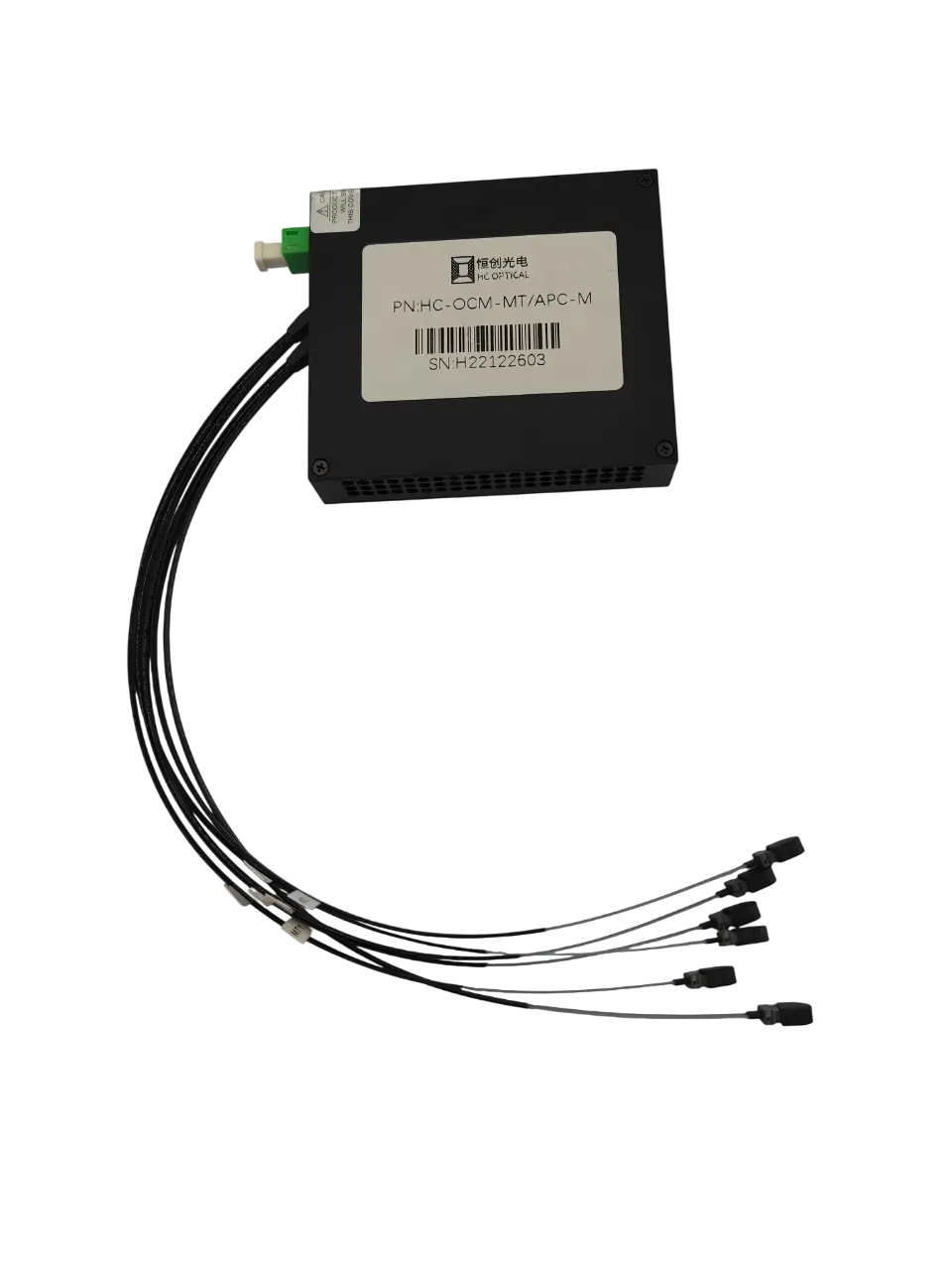
OCMs are typically deployed at strategic points in optical networks—such as ROADM nodes, line cards, and optical line systems—to provide real-time monitoring and troubleshooting through dynamic tracking of DWDM channels.
What OCMs Measure
Channel Power – The optical power level of each wavelength channel
Channel Wavelength – The exact center wavelength of each channel
Optical Signal-to-Noise Ratio (OSNR) – The ratio of signal power to noise power
Channel Spacing – The frequency spacing between adjacent channels
How Does an OCM Work?
OCMs operate through a continuous wavelength scan process combined with a built-in wavelength reference.
Working Principle
Optical Tapping – A small portion of the optical signal is tapped from the main fiber path using an optical coupler.
Wavelength Demultiplexing – The tapped signal passes through an optical tunable filter that sequentially selects individual wavelengths or spectral slices.
Power Detection – A high-grade photodetector measures the optical power at each selected wavelength.
Data Processing – Onboard electronics process the measurements and provide outputs including channel power, wavelength, and OSNR.
Key Technologies Used
|
Technology |
Description |
Advantages |
|
Tunable Optical Filter |
Sequentially scans wavelengths |
High resolution, flexible scanning |
|
Thin-Film Interference Filter |
Proprietary filter technology |
High isolation, wide passband |
|
MEMS-Based Filter |
Micro-electro-mechanical systems |
Compact size, fast switching |
GLHC Optical Channel Monitor: Key Specifications
GLHC's Optical Channel Monitor is designed for carrier-grade DWDM network monitoring applications, featuring high dynamic range, compact size, and Telcordia GR-1312-CORE compliance.
Optical Performance Specifications
|
Parameter |
Value |
Note |
|
Operation Wavelength Range |
1528–1568 nm (C-band) |
Standard C-band coverage |
|
Slice Width |
6.25 GHz |
Fine spectral resolution |
|
Slices per Slot |
6–64 |
Flexible grid support |
|
Channel Width Range |
37.5–400 GHz |
Supports flex-grid applications |
|
Modulation Format Support |
2.5G/5G/10G/40G/100G/400G |
All major formats supported |
|
Wavelength Accuracy |
±50 pm |
High precision |
|
OSNR Range |
10–25 dB |
Wide dynamic range |
|
Channel Power Range |
-40 to -10 dBm |
Broad power measurement capability |
|
Adjacent Channel Power Divergence |
6 dB |
For 40G/100G/400G |
|
Non-Adjacent Channel Power Divergence |
10 dB |
For mixed rate systems |
|
Absolute Power Accuracy |
±0.8 dB |
High measurement precision |
|
Relative Power Accuracy |
1 dB |
Consistent channel-to-channel |
|
Power Resolution |
0.1 dB |
Fine granularity |
|
Repeatability |
±0.3 dB |
Reliable measurements |
|
Scan Time (all channels) |
0.5 seconds |
Fast, single port |
|
Return Loss |
-30 dB |
Low reflection |
|
Sweep Times |
1,000 million |
Long operational life |
Optical Switch (OSW) Specifications:
The integrated optical switch enables multi-point monitoring capabilities:
|
Parameter |
Value |
|
Wavelength Range |
1520–1610 nm |
|
Polarization Dependent Loss (PDL) |
0.15 dB |
|
Return Loss |
45 dB |
|
Crosstalk |
-50 dB |
|
Repeatability |
±0.05 dB |
|
Switch Time |
75 ms |
|
Optical Power |
500 mW |
|
Durability |
1×10⁹ cycles |
To know more detailed informaiton abot Optical Channel Monitor (OCM),you can visit OCM,optical channel monitor-光通信方案提供商-恒创科技
Why OCM Specifications Matter
Wavelength Range and Accuracy
The OCM's wavelength range (1528–1568 nm) covers the full C-band, the most widely used transmission window in DWDM systems. Wavelength accuracy of ±50 pm ensures that each channel's center wavelength is precisely identified, enabling accurate channel tracking and fault detection.
Channel Power Range and Accuracy
With a channel power range of -40 to -10 dBm, GLHC's OCM can measure both very weak and moderately strong signals. Absolute power accuracy of ±0.8 dB ensures reliable power readings for gain equalization and performance monitoring.
Flex-Grid Support
The OCM's support for 6.25 GHz slice width and 37.5–400 GHz channel width enables flex-grid operation—essential for modern networks that use flexible spectrum allocation to maximize capacity.
Scan Time
A scan time of 0.5 seconds for all channels enables rapid network response—critical for dynamic network operations such as provisioning, restoration, and protection switching.
Modulation Format Independence
The OCM supports all major modulation formats from 2.5G to 400G, making it suitable for mixed-rate DWDM systems where different channels may use different modulation schemes.
Applications of Optical Channel Monitors
1. DWDM Network Monitoring
OCMs are essential components in DWDM networks for monitoring signal dynamics, determining system functionality, identifying performance changes, and providing feedback for controlling network elements. DWDM applications capture 56.7% of the OCM market, enabling C/L-band channel tracking, gain tilt compensation, and alien wavelength detection.
2. ROADM Systems
In Reconfigurable Optical Add-Drop Multiplexer (ROADM) systems, OCMs monitor channel power at add/drop points, ensuring that added channels are properly equalized with pass-through channels. Embedded OCMs, which hold a 65.8% market share, deliver integrated wavelength monitoring, power leveling, and OSNR measurement within ROADM and EDFA systems.
3. Optical Transport Networks (OTN)
OCMs are used in optical transport networks for network optimization, fault isolation, and dynamic bandwidth allocation across multi-terabit optical infrastructures. Telecommunications end-users hold 45.3% of the OCM market.
4. Data Center Interconnect (DCI)
In DCI systems, OCMs provide optical channel monitoring at the port level, enabling real-time monitoring and troubleshooting through dynamic tracking of DWDM channels with arbitrary bandwidth.
5. Fiber Monitoring and Network Management
OCMs help operators monitor power levels, detect signal degradation, and maintain overall network quality. They are powerful Layer 1 optical tools for monitoring and troubleshooting link and traffic issues.
6. Gain Equalization and Power Control
OCMs provide real-time power measurements that enable dynamic gain equalization in optical amplifiers, ensuring all channels maintain optimal power levels.
Why Choose GLHC Optical Channel Monitor?
1. Carrier-Grade Reliability
GLHC's OCM complies with Telcordia GR-1312-CORE standards, ensuring the reliability and performance required for telecom-grade deployments.
2. High-Performance Specifications
|
Feature |
GLHC OCM Advantage |
|
Wavelength Range |
Full C-band (1528–1568 nm) |
|
Wavelength Accuracy |
±50 pm – high precision channel tracking |
|
Power Range |
-40 to -10 dBm – broad measurement capability |
|
Power Accuracy |
±0.8 dB – reliable power readings |
|
Scan Time |
0.5 seconds – fast network response |
|
Modulation Support |
2.5G to 400G – all formats supported |
|
Flex-Grid Support |
6.25 GHz slices – future-proof |
3. Compact and Integrated Design
With integrated 1×8 switch capability, GLHC's OCM enables multi-point monitoring from a single device, reducing cost, footprint, and power consumption.
4. Long-Term Reliability
With 1 billion sweep times and optical switch durability of 1×10⁹ cycles, GLHC's OCM is built for years of continuous operation.
5. Modulation Format Independence
The OCM supports 2.5G/5G/10G/40G/100G/400G signals, making it ideal for mixed-rate DWDM systems.
6. Expert Technical Support
GLHC provides comprehensive pre-sales consulting, design-in support, and after-sales technical assistance to ensure successful deployment and operation.
Conclusion
Optical Channel Monitors have become essential tools for modern DWDM network management. As networks grow in capacity and complexity, the ability to monitor individual wavelength channels in real-time—measuring power, wavelength, and OSNR—is critical for maintaining signal quality, optimizing performance, and quickly identifying faults.
With the global OCM market projected to reach a new height now is the time to invest in high-quality optical monitoring solutions.
GLHC's Optical Channel Monitor delivers the performance, reliability, and flexibility that network operators need.
For more details on OCM products, you can visit our website OCM,optical channel monitor-光通信方案提供商-恒创科技or-光通信方案提供商-恒创科技.
Related news
- Key Parameters of Optical Communication Equipment: A Comprehensive Guide
- Why Optical Circuit Switching Is Suddenly Everywhere (And What It Means for Your Network)
- C-Band vs L-Band: Key Differences and Overview of All 6 Optical Bands
- Matrix Optical Switch Module (Matrix Switch)
- Three Types of Optical Switches Compared: MEMS vs. Mechanical vs. Magneto-Optic
- A full range of polarization-maintaining components are available with customization options
- New product launch
- SVIAZ 2026- booth number is 2E086
- China-Central Asia (Uzbekistan) Trade Exhibition 2025
- Utility model patent----"A matrix optical switching device"
