
Photodetector Module Guide: Types, Applications, Specifications and Selection Tips
Updated at Aug 26th 2026 Views 564
Introduction
Choosing the right photodetector module is critical for optical communication systems, fiber optic sensing, OCT, LIDAR, and high-speed test applications. Different detector technologies, such as PIN photodetectors, APD avalanche photodetectors, balanced photodetectors, and wideband photoreceivers, vary significantly in sensitivity, bandwidth, noise performance, gain, and cost.
This guide explains how photodetectors work, compares common photodetector module types, and provides practical selection tips to help engineers and system integrators choose the most suitable optical detection solution.
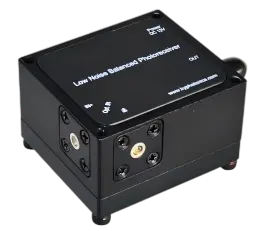
The picture of Balanced Photodetector Module
What Is a Photodetector?
A photodetector is an optoelectronic device that detects light and converts it into an electrical signal through the photoelectric effect. In fiber optic communication systems, photodetectors are essential for receiving optical signals transmitted through optical fibers and converting them back into electrical signals for further processing.
Photodetectors are characterized by several critical performance parameters:
Responsivity: The ratio of electrical output to optical input power
Bandwidth: The range of frequencies the detector can respond to
Dark current: The leakage current when no light is incident
Noise equivalent power (NEP): The minimum detectable optical power
Quantum efficiency: The percentage of incident photons that generate electron-hole pairs
Types of Photodetectors Available
HC Optical offers a diverse portfolio of photodetector modules to address various application needs:
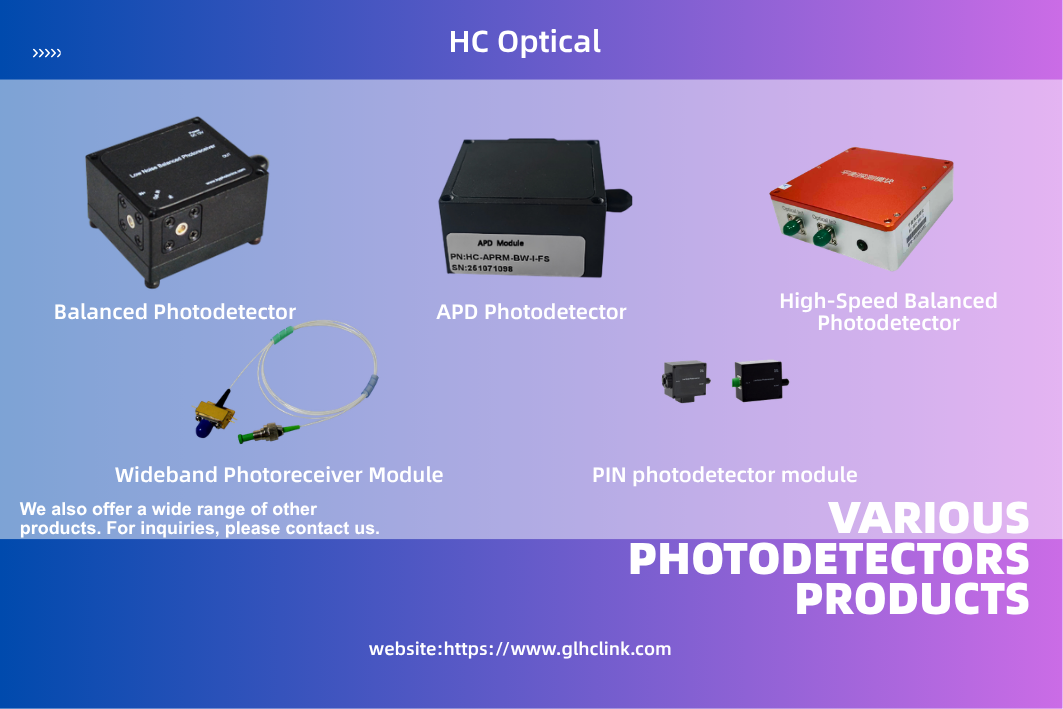
Various Photodetectors Products
1. PIN Photodetector Module
PIN photodetectors are among the most widely used optical receivers in fiber optic communication systems. They feature a P-I-N semiconductor structure with an intrinsic (I) layer between the P and N regions, which increases the depletion region width and improves quantum efficiency.
Key advantages:
High-speed response
Low dark current
Excellent linearity over a wide dynamic range
Cost-effective for most standard applications
PIN photodetectors are ideal for applications requiring high-speed data transmission, such as telecommunications, data center interconnects, and local area networks.
Explore our PIN Photodetector Module
2. Wideband Photoreceiver Module
Wideband photoreceiver modules integrate a photodetector with a transimpedance amplifier (TIA) to provide a complete optical-to-electrical conversion solution. These modules offer:
Broad frequency response covering multiple wavelength bands
High gain and low noise performance
Compact form factor for space-constrained designs
Simplified integration into optical systems
These modules are particularly suitable for RF-over-fiber applications, wideband signal processing, and instrumentation.
View Wideband Photoreceiver Module
3. Balanced Optical Detection Module
Balanced photodetectors consist of two matched photodiodes that enable differential detection. This configuration provides:
Common-mode noise rejection: Effectively cancels laser intensity noise
Improved signal-to-noise ratio: Essential for coherent detection systems
Enhanced dynamic range: Suitable for high-performance optical measurements
Balanced detection modules are widely used in coherent optical communication, optical coherence tomography (OCT), and interferometric sensing applications.
Learn more about Balanced Optical Detection Modules
4. APD Avalanche Photodetection Module
Avalanche photodiodes (APDs) offer internal gain through the avalanche multiplication effect, making them ideal for detecting weak optical signals. Key features include:
High sensitivity: Capable of detecting extremely low optical power levels
Internal gain: Amplifies the photocurrent before the first amplification stage
Wide dynamic range: Suitable for varying signal strength conditions
APD modules are the preferred choice for long-haul fiber optic communication, free-space optical communication, LIDAR, and other applications requiring high sensitivity.
Check APD Avalanche Photodetector Modules
Key Applications of Photodetectors
Photodetectors find applications across a wide spectrum of industries and technologies:
Optical Communications
Photodetectors are the receiving-end workhorses of fiber optic networks. From short-reach data center interconnects to long-haul submarine cables, photodetectors enable the high-speed, low-latency data transmission that powers the modern internet.
Sensing and Monitoring
In fiber optic sensing systems, photodetectors convert reflected or transmitted light signals into measurable electrical outputs. Applications include:
Distributed temperature and strain sensing
Fiber Bragg grating (FBG) sensor demodulation
Optical time-domain reflectometry (OTDR) for fiber characterization
Optical channel monitoring (OCM) in DWDM networks
Biomedical Applications
Photodetectors play a crucial role in biomedical imaging and diagnostics, including:
Optical coherence tomography (OCT) for retinal imaging
Flow cytometry for cell analysis
Fluorescence microscopy
Laser-based therapeutic and diagnostic equipment
LIDAR and Autonomous Systems
APD-based photodetectors are essential components in LIDAR systems for autonomous vehicles, providing the high sensitivity needed to detect distant objects in varying environmental conditions.
Aerospace and Defense
Photodetectors are used in free-space optical communication, missile guidance systems, and various defense-related optical sensing applications where reliability and performance are paramount.
Key Photodetector Specifications You Should Know
When selecting a photodetector module, engineers should evaluate several key specifications that directly affect system performance.
Responsivity
Responsivity indicates how efficiently a photodetector converts optical power into electrical current. It is usually expressed in A/W. Higher responsivity means stronger electrical output for the same optical input power.
Bandwidth
Bandwidth determines the maximum signal frequency or data rate that the photodetector can support. High-speed optical communication and RF-over-fiber systems typically require wide bandwidth photodetector modules.
Dark Current
Dark current is the current generated when no light is incident on the detector. Lower dark current helps improve sensitivity and signal-to-noise ratio.
Noise Equivalent Power
Noise equivalent power, or NEP, represents the minimum optical power that can be detected above the noise floor. A lower NEP indicates better low-light detection capability.
Quantum Efficiency
Quantum efficiency describes the percentage of incident photons converted into electron-hole pairs. It is closely related to detector sensitivity and wavelength response.
How to Choose the Right Photodetector
Selecting the appropriate photodetector for your application requires careful consideration of several factors:
Browse all Photodetector Products
|
Parameter |
PIN Photodiode |
APD |
Balanced Detector |
|
Sensitivity |
Moderate |
High |
High (with noise rejection) |
|
Bandwidth |
High |
Moderate-High |
High |
|
Gain |
None (1x) |
10-100x |
Differential |
|
Cost |
Low-Moderate |
Moderate-High |
Moderate-High |
|
Best for |
Short-haul, high-speed |
Long-haul, low-light |
Coherent, noise-sensitive |
To choose the right photodetector module, consider the following steps:
1. Define the operating wavelength, such as 850 nm, 1310 nm, or 1550 nm.
2. Determine the required bandwidth or data rate.
3. Estimate the expected optical input power range.
4. Evaluate sensitivity, responsivity, dark current, and NEP.
5. Choose between PIN, APD, balanced, or wideband photoreceiver modules.
6. Consider package type, connector interface, output format, and integration requirements.
7. Verify environmental reliability and long-term stability for your application.
PIN Photodetector vs APD vs Balanced Photodetector
A PIN photodetector is generally preferred for high-speed, cost-sensitive optical communication links where the received optical power is sufficient. It offers low noise, fast response, and excellent linearity.
An APD avalanche photodetector is better suited for applications requiring higher sensitivity, such as long-distance fiber transmission, LIDAR, and weak signal detection. Its internal gain improves detection capability but requires higher bias voltage and careful noise management.
A balanced photodetector is designed for differential optical detection. It is commonly used in coherent communication, OCT, interferometry, and other systems where common-mode noise rejection and high signal-to-noise ratio are important.
Why Choose HC Optical Photodetector Modules?
HC Optical provides a range of photodetector and photoreceiver solutions for optical communication, sensing, test and measurement, and high-speed detection applications. Our product portfolio includes PIN photodetector modules, APD avalanche photodetector modules, balanced optical detection modules, and wideband photoreceiver modules.
With experience in communication devices and integrated optical equipment, HC Optical supports customers with product selection, technical consultation, and customized optical detection solutions for different system requirements.
Conclusion
Photodetectors are indispensable components in modern optical systems, enabling the conversion of light into electrical signals with precision and speed. Whether you require the high-speed response of PIN photodiodes, the sensitivity of APDs, or the noise rejection of balanced detectors, understanding the characteristics and trade-offs of each type is essential for optimal system design.
HC Optical's comprehensive photodetector portfolio—including PIN photodetector modules, wideband photoreceiver modules, balanced optical detection modules, and APD avalanche photodetection modules—provides solutions for applications ranging from telecommunications to biomedical imaging.
For more information about photodetector products and custom solutions, visit HC Optical's product page or contact their expert team at
Related news
- Optical Line Protection (OLP): Features, Applications, and Working Principle
- MEMS Optical Circuit Switch Selection Guide: How to Choose the Right Rackmount OCS
- Optical Amplifiers: The Engine Behind Modern Fiber Optic Networks
- Single Mode vs Multimode Fiber: Key Differences and How to Choose
- Optical Switch Comparison: MEMS vs Magneto-Optic vs Mechanical vs OCS
- Comprehensive Guide to Optical Isolators: Types, Working Principles, and Applications
- Comprehensive Guide to WDM Technology: Products, Applications, and Solutions
- How to Choose a Photodetector for Optical Communication Systems
- Why AWG Is the Preferred Choice for Next-Generation Optical Multiplexing
- The Essential Role of Optical Switches in Modern Test and Measurement Applications
