
Comprehensive Guide to WDM Technology: Products, Applications, and Solutions
Updated at Sep 03rd 2026 Views 356
Introduction
Wavelength Division Multiplexing (WDM) is a cornerstone technology in modern optical communication networks. By combining multiple optical signals at different wavelengths onto a single optical fiber, WDM dramatically increases the transmission capacity of fiber infrastructure without the need for additional cables. Whether you are building a data center interconnect, a metropolitan area network, or a long-haul transmission system, understanding WDM technology and its various implementations is essential for optimizing network performance and cost-efficiency.
At HC Optical, we offer a comprehensive portfolio of WDM solutions designed to meet the diverse needs of communication networks, data centers, and IoT applications. This guide explores the fundamentals of WDM technology, the different types of WDM products available, and how to choose the right solution for your specific requirements.
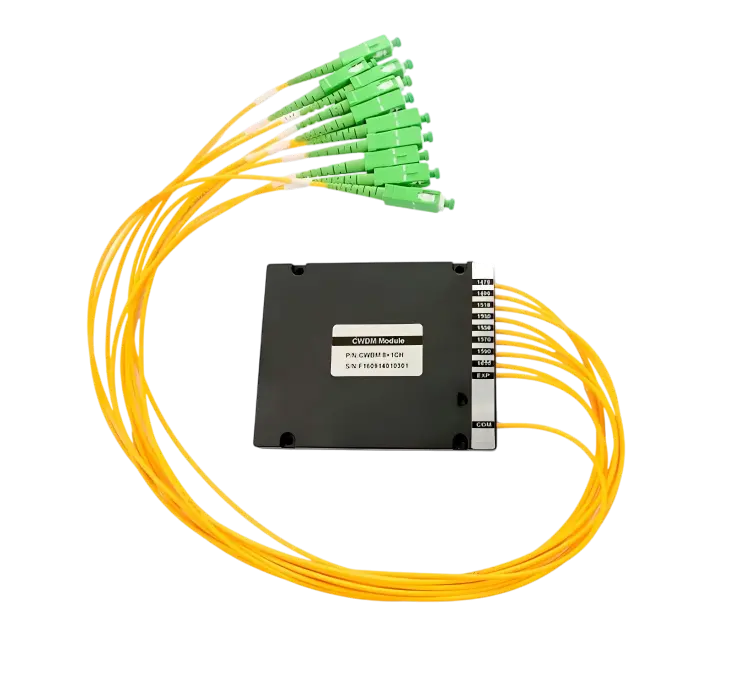
HC Optical CWDM Products
What Is WDM?
Wavelength Division Multiplexing is a technique that multiplexes multiple optical carrier signals on a single optical fiber by using different wavelengths (colors) of laser light. Each independent wavelength carries a separate data channel, allowing the fiber to transport multiple signals simultaneously. This is analogous to how different radio stations broadcast on different frequencies—each station is independent, yet they all share the same airwaves.
The key advantage of WDM is that it leverages the enormous bandwidth potential of optical fiber. Instead of installing new fiber cables to increase capacity, network operators can upgrade their existing infrastructure with WDM equipment to multiply the available bandwidth by factors of 8, 16, 32, 40, or even 80 times or more.
Types of WDM Technologies
WDM technology can be broadly categorized based on channel spacing and the number of wavelengths supported. The most common variants are CWDM, DWDM, FWDM, CCWDM, and LAN WDM.
Various kinds of WDM Products provided by HC Optical.
CWDM (Coarse Wavelength Division Multiplexing)
CWDM uses wider channel spacing—typically 20 nm—which allows for the use of uncooled lasers and simpler, more cost-effective components. CWDM systems generally support up to 18 channels across the 1270 nm to 1610 nm wavelength range.
Key Features:
Wider channel spacing
Lower cost due to relaxed component specifications
Shorter transmission distances (typically up to 80-100 km)
Ideal for metropolitan area networks and enterprise applications
Common CWDM Products:
1x2 CWDM Devices
8CH, 18CH CWDM Modules
CWDM OADM (Optical Add-Drop Multiplexer) Modules
CWDM in 1U Rackmount configurations
Choose your CWDM Products
DWDM (Dense Wavelength Division Multiplexing)
DWDM employs much tighter channel spacing—typically 0.8 nm (100 GHz) or 0.4 nm (50 GHz)—enabling the transmission of 40, 80, or even more channels over a single fiber. DWDM systems operate primarily in the C-band (1530-1565 nm) and L-band (1565-1625 nm), where optical amplifiers like EDFA are most effective.
Key Features:
Dense channel spacing for maximum capacity
Supports long-haul and ultra-long-haul transmission
Requires cooled lasers and precise wavelength control
Compatible with optical amplification (EDFA, Raman amplifiers)
Common DWDM Products:
100G DWDM Modules
200G DWDM Modules
100G/200G DWDM OADM Modules
DWDM Devices in rackmount configurations
Choose your DWDM Products
FWDM (Filter Wavelength Division Multiplexing)
FWDM, also known as Thin-Film Filter WDM, uses thin-film interference filters to combine and separate wavelengths. This technology is particularly well-suited for applications requiring low insertion loss, high isolation, and excellent environmental stability.
Key Applications:
Fiber-to-the-home (FTTH) networks
Coexistence of multiple network generations (e.g., GPON and XGS-PON)
WDM-PON systems
Choose your FWDM Products
CCWDM (Compact Coarse Wavelength Division Multiplexing)
CCWDM is a compact variant of CWDM that uses free-space optics technology to achieve smaller form factors while maintaining similar performance characteristics.
Key Advantages:
Ultra-compact size
Low insertion loss
High channel isolation
Ideal for space-constrained applications
Choose your CCWDM Products
LAN WDM
LAN WDM is a wavelength grid defined for 100G and 400G Ethernet applications, particularly in data center interconnects. It uses four specific wavelengths in the 1300 nm range (typically 1295.56 nm, 1300.05 nm, 1304.58 nm, and 1309.14 nm).
Key Applications:
100G LR4 and 400G DR4/FR4 transceivers
Data center interconnect (DCI)
High-speed enterprise networks
Choose your LAN WDM Products
WDM Product Families
AWG (Arrayed Waveguide Grating)
AWG is a planar lightwave circuit (PLC) device that functions as a wavelength multiplexer/demultiplexer. It is widely used in DWDM systems due to its ability to handle a large number of channels with low loss and high stability.
Key Features:
Integrated planar lightwave circuit technology
Supports up to 40 or more channels
Low insertion loss and high uniformity
Temperature-stabilized and athermal options available
Choose your AWG Products
To know more information about AWG((Arrayed Waveguide Grating) you can also read this article (Why AWG Is the Preferred Choice for Next-Generation Optical Multiplexing)
Fused WDM
Fused WDM devices are manufactured using fused biconical taper (FBT) technology, where two or more optical fibers are fused and tapered to create wavelength-selective coupling.
Key Features:
Cost-effective manufacturing
Low polarization-dependent loss
Suitable for low-channel-count applications
Choose your Fused WDM Products
ISO+WDM (Isolator + WDM Integrated Modules)
These integrated modules combine a WDM filter with an optical isolator in a single compact package, saving space and reducing insertion loss.
Key Applications:
Optical amplifiers (EDFA, Raman)
Laser modules
Test and measurement equipment
Choose your ISO+WDM Products
Applications of WDM Technology
Data Center Interconnect (DCI)
With the explosive growth of cloud computing and AI workloads, data centers require massive bandwidth for interconnection. WDM technology enables cost-effective, high-capacity links between data centers using existing fiber infrastructure.
Metropolitan Area Networks (MAN)
CWDM and DWDM are widely deployed in metropolitan networks to connect multiple sites, support enterprise services, and aggregate traffic from access networks.
Long-Haul and Submarine Networks
DWDM with optical amplification enables transmission over thousands of kilometers, making it the technology of choice for long-haul terrestrial and submarine cable systems.
5G Transport Networks
The rollout of 5G networks requires high-capacity, low-latency transport. WDM technologies, particularly CWDM and DWDM, are critical for fronthaul, midhaul, and backhaul applications.
AI Intelligent Computing Centres
Modern AI workloads demand massive data movement between computing nodes. WDM-based optical interconnects provide the bandwidth and low latency required for AI cluster networking.
How to Choose the Right WDM Solution
|
Requirement |
Recommended Technology |
|
Short distance, cost-sensitive |
CWDM |
|
Long distance, high capacity |
DWDM with EDFA |
|
FTTH/PON coexistence |
FWDM |
|
Space-constrained |
CCWDM |
|
100G/400G data center |
LAN WDM |
|
Dynamic wavelength management |
ROADM with AWG |
Key factors to consider:
Transmission distance: CWDM for <80 km, DWDM for >80 km
Channel count: CWDM supports up to 18 channels; DWDM supports 40-80+
Budget: CWDM is more cost-effective; DWDM requires higher investment but offers greater capacity
Future scalability: DWDM provides more room for expansion
Existing infrastructure: Consider whether you already have dark fiber or lit fiber
Why Choose HC Optical for Your WDM Needs?
HC Optical is a leading provider of optical communication solutions, specializing in the research, development, production, and sales of communication devices and integrated equipment. With a focus on optical communication, IoT, and data center applications, we offer:
Comprehensive Product Portfolio: From basic WDM devices to complete DWDM systems
Customization Capabilities: Tailored solutions for specific wavelength, form factor, and performance requirements
Quality Assurance: Rigorous testing and qualification processes
Expert Technical Support: Dedicated team to assist with system design and deployment
One-Stop Solutions: Integrated offerings covering all aspects of optical network infrastructure
Conclusion
WDM technology continues to evolve as the demand for bandwidth grows exponentially. Whether you are deploying CWDM for cost-effective metropolitan connectivity or DWDM for high-capacity long-haul transmission, understanding the various WDM technologies and product options is crucial for building efficient, scalable optical networks.
HC Optical's extensive WDM product line—including AWG, CWDM, DWDM, FWDM, CCWDM, LAN WDM, ISO+WDM, and Fused WDM devices—provides the flexibility and performance needed to address a wide range of applications. From individual components to complete system solutions, our expertise ensures that your optical network is optimized for today's requirements and ready for tomorrow's challenges.
Related news
- Intensity Modulator Guide: LiNbO₃, TFLN, Specs & Applications
- Optical Switches in High-Speed Optical Module Test Platforms: A Research Report
- Optical Line Protection (OLP): Features, Applications, and Working Principle
- MEMS Optical Circuit Switch Selection Guide: How to Choose the Right Rackmount OCS
- Optical Amplifiers: The Engine Behind Modern Fiber Optic Networks
- Single Mode vs Multimode Fiber: Key Differences and How to Choose
- Optical Switch Comparison: MEMS vs Magneto-Optic vs Mechanical vs OCS
- Comprehensive Guide to Optical Isolators: Types, Working Principles, and Applications
- How to Choose a Photodetector for Optical Communication Systems
- Why AWG Is the Preferred Choice for Next-Generation Optical Multiplexing
