
Low noise fiber amplifier
Updated at Oct 27th 2023 Views 8974
Our modular fiber amplifier products are mainly characterized by small size and low power consumption. The use of small devices and small bending radius optical fiber, the EDFA size from the MSA standard, reduced to 50*50*10, even 50*30*8mm, can achieve single-wave amplification, multi-wave flat amplification and other different needs, widely used in metropolitan area networks, Lidar, coherent detection systems, radar systems.
It can realize the power amplification of the optical signal in the input broadband and ensure the consistency of the output power in the band. Closed-loop control of output optical power to achieve stable output of all ambient power; Monitor and report the input and output optical power inside the module; When the input power is lower than the input power threshold, the module automatically stands by, and automatically restores the output after the input light recovers.
Parameters such as working wavelength, working mode and communication mode can be customized according to requirements.
For specific product parameters, see the - Low noise Fiber Amplifier product page.
The following is the recent physical photos of our shipment:
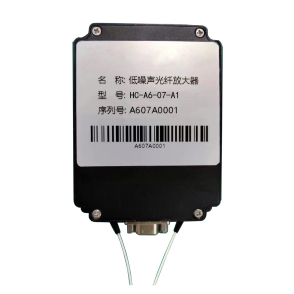
The storage room of the low-noise optical fiber amplifier should be rain and dust proof, the ambient temperature should be 15 ° C to +35 ° C, and the humidity should be 35% to 60%. The room should be free from acid, alkali, and corrosive gases, and free from strong mechanical vibration, shock, and strong magnetic field.
Website upload information is limited, more types of modulators can contact our manager Peng, tel 18607733834 (wechat same number), email cicy@glhcoptical.com.
Products can be customized according to demand, welcome to inquire.
Related news
- Large Core Fiber Patch Cord Guide: General-Purpose, Infrared, and UV Specialty Fiber Cables
- The Lithium Niobate IQ Modulator: for High-Order Coherent Optical Transmission
- Phase Modulator: A Complete Guide to Electro-Optic Phase Modulators for Coherent Systems
- Intensity Modulator Guide: LiNbO₃, TFLN, Specs & Applications
- Optical Switches in High-Speed Optical Module Test Platforms: A Research Report
- Optical Line Protection (OLP): Features, Applications, and Working Principle
- MEMS Optical Circuit Switch Selection Guide: How to Choose the Right Rackmount OCS
- Optical Amplifiers: The Engine Behind Modern Fiber Optic Networks
- Single Mode vs Multimode Fiber: Key Differences and How to Choose
- Optical Switch Comparison: MEMS vs Magneto-Optic vs Mechanical vs OCS
