
C-Band vs L-Band: Key Differences and Overview of All 6 Optical Bands
Updated at Jul 20th 2026 Views 1411
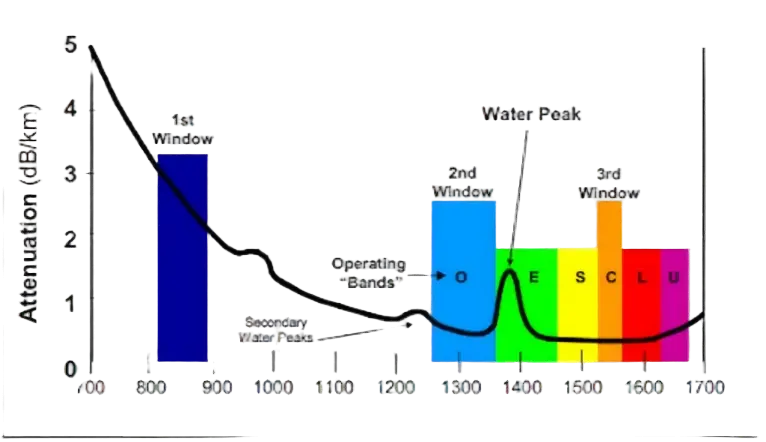
Modern fiber-optic communication networks rely on specific wavelength ranges—known as optical wavelength bands—where silica-based optical fibers exhibit minimal transmission loss and dispersion. These bands, standardized by the International Telecommunication Union (ITU-T), serve as distinct "channels" through which light travels, forming the physical foundation for high-density, scalable optical networks.
The low-loss transmission window of standard single-mode fibers spans approximately 1260 nm to 1675 nm. Within this window, the ITU-T has defined six primary bands: O, E, S, C, L, and U. This article provides a comprehensive overview of each band, including their full names, wavelength ranges, key characteristics, and primary applications.
The Optical Wavelength Bands
O-Band (Original Band)
Wavelength Range: 1260–1360 nm
The O-band is the original wavelength band—the first band historically used for single-mode fiber communications. Its most distinctive characteristic is minimal chromatic dispersion, which results in the lowest signal distortion among all bands. While its attenuation is moderate compared to longer-wavelength bands, the dispersion advantage makes it highly attractive for certain applications.
Primary Applications:
Short-reach optical links and metro networks
Upstream transmission in Passive Optical Network (PON) systems
High-speed Ethernet standards such as IEEE 100GBASE-LR4 and 400GBASE-LR8
Data center interconnects and enterprise backbones
Optical interconnects over short distances (100 m to 1 km)
E-Band (Extended Band)
Wavelength Range: 1360–1460 nm
The E-band stands for extended wavelength band. Historically, this band suffered from high attenuation due to water peak loss caused by hydroxyl (OH⁻) impurities in early optical fibers. This limitation earned it a reputation as a "problematic" band and restricted its large-scale deployment for many years.
However, with the advent of Zero Water Peak (ZWP) fiber manufacturing techniques, attenuation in the E-band has been dramatically reduced—in some cases even below that of the O-band. This technological advancement has reopened the E-band for commercial applications.
Primary Applications:
Metro networks and regional optical systems requiring additional bandwidth
Emerging multi-band WDM systems
CWDM systems spanning 1270–1610 nm
S-Band (Short Wavelength Band)
Wavelength Range: 1460–1530 nm
The S-band is the short wavelength band. It offers lower transmission loss than the O-band while maintaining good compatibility with optical components. The band strikes a favorable balance between attenuation and component performance, making it particularly well-suited for access network applications.
Primary Applications:
Downstream transmission in PON and FTTH (Fiber to the Home) networks, especially at the 1490 nm wavelength
Access networks and emerging WDM extensions
A key research direction for next-generation ultra-high-bandwidth optical network expansion
Emerging S+C+L-band systems (20 THz wide) are being increasingly explored
C-Band (Conventional Band)
Wavelength Range: 1530–1565 nm
The C-band is the conventional wavelength band and represents the most widely used and technologically mature core band in global optical communication networks. Its defining characteristic is the lowest fiber attenuation across the entire transmission spectrum.
The C-band's dominance is further reinforced by the availability of Erbium-Doped Fiber Amplifiers (EDFAs) , which provide efficient optical amplification precisely within this wavelength range. These factors have made the C-band the backbone of long-haul and ultra-long-haul transmission systems worldwide.
Primary Applications:
Dense Wavelength Division Multiplexing (DWDM) systems
Long-haul and backbone networks
Submarine optical cable communications
The primary operating band for most commercial transceivers and optical components
L-Band (Long Band)
Wavelength Range: 1565–1625 nm
The L-band is the long wavelength band. It exhibits slightly higher attenuation than the C-band but still offers the second-lowest transmission loss among all bands. The L-band is primarily used to expand DWDM capacity beyond what the C-band alone can provide.
Like the C-band, the L-band is compatible with EDFA amplification, though specialized L-band EDFAs are required. By utilizing both C- and L-bands, network operators can effectively double the available spectral bandwidth.
Primary Applications:
Expanding DWDM capacity in high-throughput systems
Supplementing C-band networks to increase overall transmission capacity
High-capacity backbone and submarine cable systems
Supporting 400GE/800GE service transmission
C+L Band (C-Band and L-Band Combined)
While C-band and L-band are distinct wavelength ranges, they are increasingly treated as an integrated C+L band in modern optical network design. The extended C-band (1524–1572 nm) and extended L-band (1575–1626 nm) together expand spectral bandwidth from approximately 6 THz to 12 THz.
C+L integrated solutions enable network operators to double transport capacity without laying new fiber cables. Unified C+L-band systems also reduce hardware redundancy, minimize operational costs, and simplify network architecture. Modern components such as optical transceivers, Wavelength Selective Switches (WSS), and amplifiers now support arbitrary tuning and scheduling across the full C+L spectrum.
Primary Applications:
Ultra-high-capacity DWDM transmission systems
Next-generation 5G all-optical networks
Submarine cable systems
High-speed data center interconnects requiring maximum fiber utilization
U-Band (Ultra-Long Wavelength Band)
Wavelength Range: 1625–1675 nm
The U-band is the ultra-long wavelength band. It represents the longest wavelength segment within the standard low-loss transmission window. Due to higher attenuation and limited amplifier availability, the U-band is not widely used for mainstream data transmission.
Instead, the U-band is primarily reserved for network monitoring and maintenance. Wavelengths such as 1625 nm and 1650 nm are used for in-service fiber testing using Optical Time-Domain Reflectometers (OTDRs). Because these wavelengths sit beyond the standard C- and L-bands used for data traffic, operators can perform real-time monitoring without interfering with live transmissions.
Recent research has also explored the U-band for expansion of communication bands through advanced amplification technologies such as Raman amplifiers and wavelength converters.
Primary Applications:
Fiber optic testing and maintenance (OTDR)
In-service network monitoring without disrupting live traffic
Emerging research in multi-band transmission systems
Specialized applications including gas sensing and LIDAR
Summary Table
|
Band |
Full Name |
Wavelength Range |
Key Characteristic |
Primary Application |
|
O-Band |
Original |
1260–1360 nm |
Minimal dispersion |
Short-reach links, PON upstream |
|
E-Band |
Extended |
1360–1460 nm |
Historically limited by water peak |
Metro networks, CWDM |
|
S-Band |
Short |
1460–1530 nm |
Moderate loss |
PON downstream, FTTH |
|
C-Band |
Conventional |
1530–1565 nm |
Lowest attenuation |
Long-haul DWDM, backbone |
|
L-Band |
Long |
1565–1625 nm |
Second-lowest loss |
Capacity expansion |
|
C+L Band |
Combined |
1530–1625 nm |
12 THz bandwidth |
Ultra-high-capacity systems |
|
U-Band |
Ultra-Long |
1625–1675 nm |
Highest loss |
Network monitoring, OTDR |
Conclusion
The ITU-T standardized optical wavelength bands—O, E, S, C, L, and U—provide the foundational framework for modern fiber-optic communication networks. Each band offers distinct physical properties that determine its suitability for different applications, from short-reach data center interconnects to ultra-long-haul submarine cables.
The C-band remains the global workhorse due to its lowest attenuation and mature EDFA technology. The L-band serves as its natural complement for capacity expansion, and together they form the C+L band—the current frontier for ultra-high-capacity transmission. Meanwhile, the O-band continues to play a vital role in short-reach and access networks, while the S-band and E-band are gaining renewed interest as the industry pushes toward full-spectrum utilization.
As network traffic continues to grow exponentially, the industry is increasingly exploring ultra-wideband transmission across all six bands—from the O-band through the U-band—to maximize the capacity of existing fiber infrastructure.
Related news
- Optical Amplifiers: The Engine Behind Modern Fiber Optic Networks
- Single Mode vs Multimode Fiber: Key Differences and How to Choose
- Optical Switch Comparison: MEMS vs Magneto-Optic vs Mechanical vs OCS
- Comprehensive Guide to Optical Isolators: Types, Working Principles, and Applications
- Comprehensive Guide to WDM Technology: Products, Applications, and Solutions
- How to Choose a Photodetector for Optical Communication Systems
- Why AWG Is the Preferred Choice for Next-Generation Optical Multiplexing
- Photodetector Module Guide: Types, Applications, Specifications and Selection Tips
- The Essential Role of Optical Switches in Modern Test and Measurement Applications
- SFP Transceiver Modules 2026: The Ultimate Buying Guide for Network Engineers
